QIS-Powered ETPs: A Better Product Stack Onchain
How QIS-powered ETPs combine machine learning, onchain composability, and smart contracts operational efficiency to improve risk-adjusted outcomes.

QIS-powered ETPs are one way to reconsider basket investing for institutional allocators: they combine the distribution advantages of an exchange-traded wrapper with the rigor of quantitative portfolio construction.
The underlying idea is straightforward: apply QIS methodology to improve diversification and risk-adjusted performance step by step, then deploy that logic through programmable onchain vault infrastructure. This note uses the 21Shares Bitcoin Gold ETP and the Vinter ByteTree BOLD1 methodology as a public reference benchmark (21Shares & Vinter methodology), then walks through how QIS-driven upgrades and onchain implementation each changed risk-adjusted performance in this sample.
Faithful Replication of the Public Benchmark
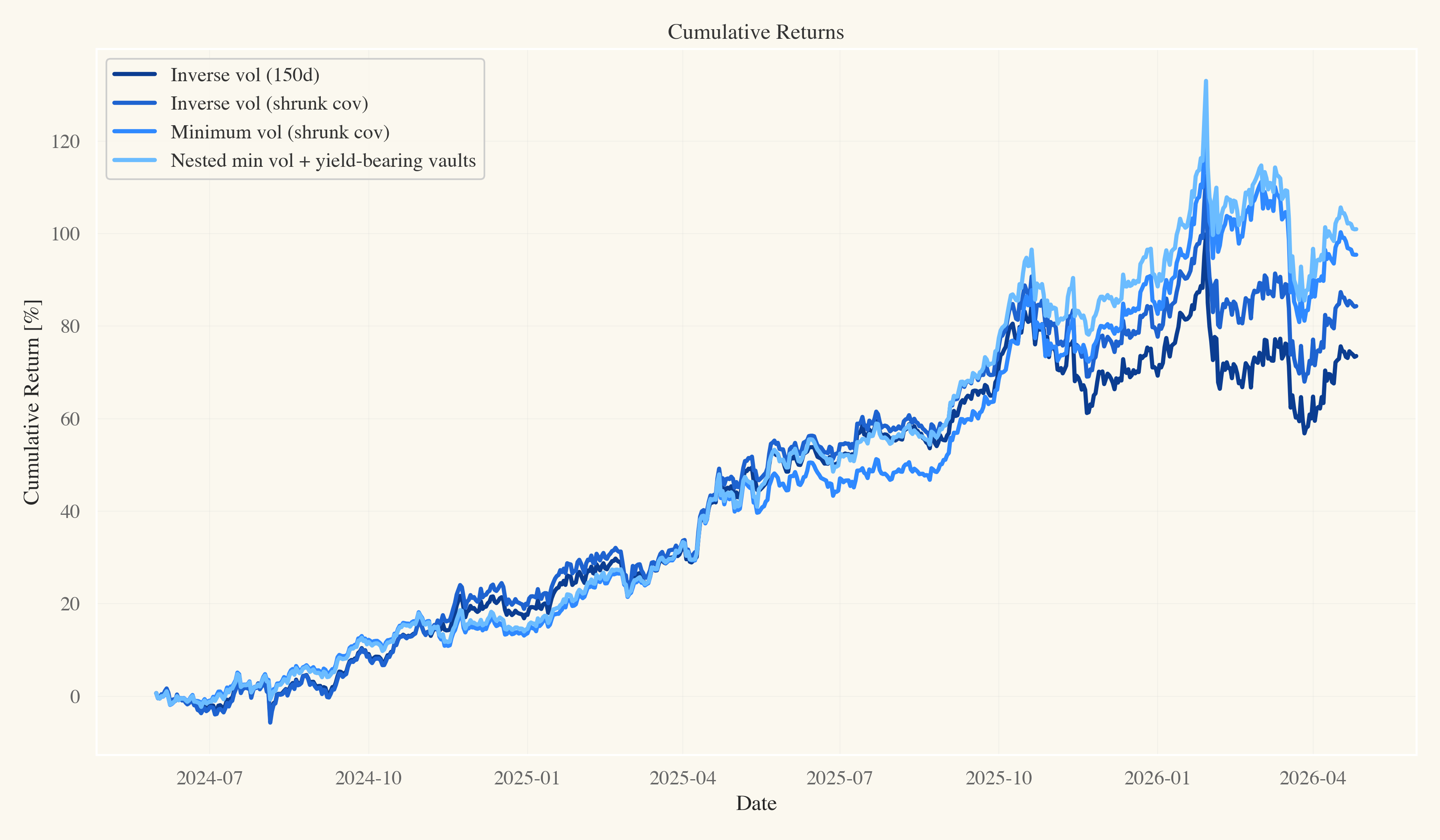
As a baseline, this note reproduces the reference inverse-volatility methodology using sample volatility estimation (Sharpe ratio: 1.22):
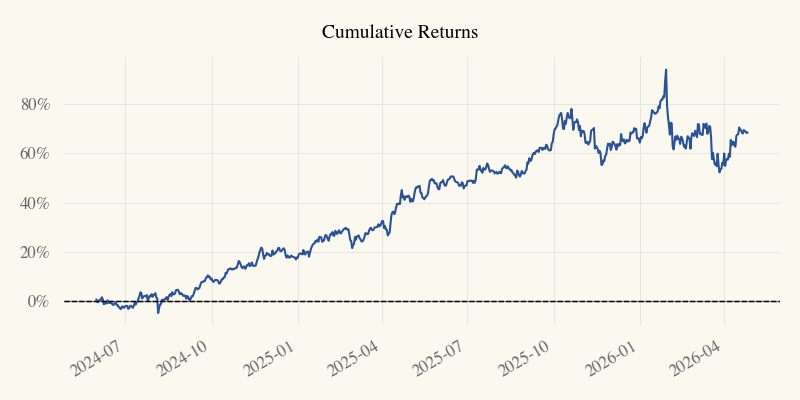
That baseline provides a clean reference point for attributing each subsequent change to a specific cause rather than to the basket as a whole.
Better Risk Estimation
The first upgrade keeps the same inverse-volatility construction but replaces naive sample estimates with skfolio-based routines and shrunk covariance estimation (Sharpe ratio: 1.36):
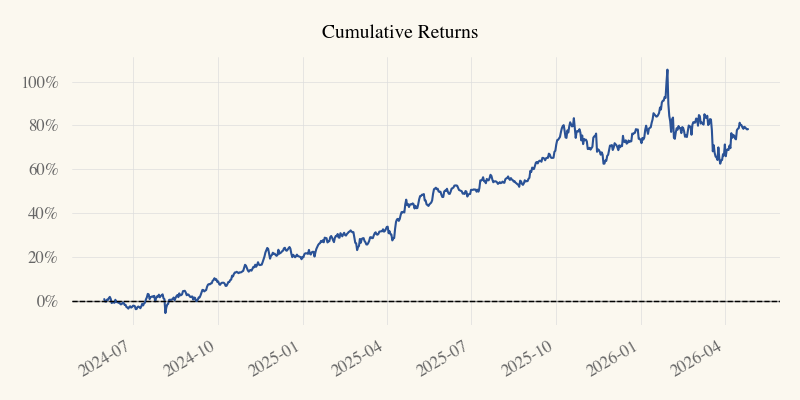
In this sample, shrinkage improved the robustness of risk estimates, particularly in noisier regimes, without changing the underlying weighting rule.
From Inverse Volatility to Minimum Volatility
The second upgrade addresses a structural limitation rather than an estimation issue: inverse-volatility weighting scales each sleeve by its own volatility and does not use cross-asset correlation information at all.
Moving to minimum-volatility optimization under the same risk estimation framework changed the result (Sharpe ratio: 1.59):
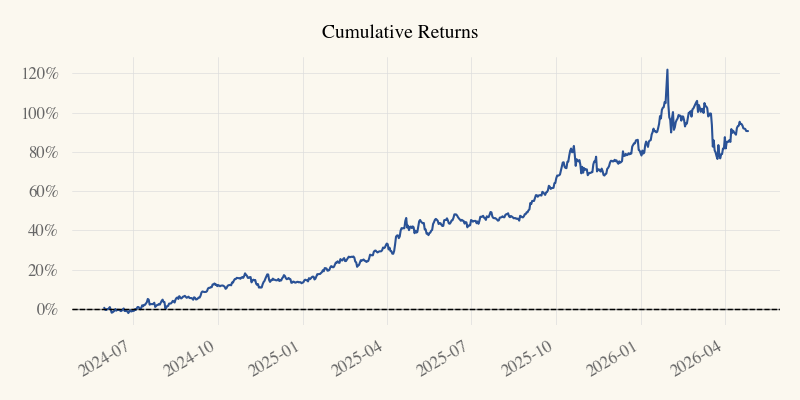
This is a shift in kind, not only in degree: from scaling each sleeve independently to optimizing the joint basket using the full covariance structure.
Onchain Yield-Bearing Implementation
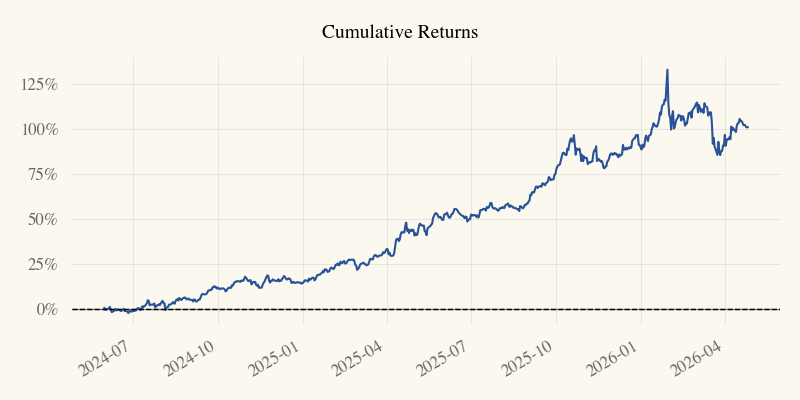
The final upgrade in this note comes from implementation rather than methodology. By accessing BTC/XAU-denominated yield-bearing vaults onchain, the strategy kept its diversification profile while adding a further, onchain-native return component (Sharpe ratio: 1.74):
Why Onchain Vault Implementation Matters
These stepwise results are shown on nominal returns only; they do not yet include the additional operational efficiency (on the order of tens of basis points) that automating methodology execution, rebalancing, and controls through Orion's smart contracts could plausibly add on top.
That gap points to the real contrast between offchain basket products, such as traditional ETPs, and onchain vaults: the portfolio logic can be similar or identical, but the operating model underneath it is not.
In offchain structures, a meaningful share of cost and friction sits in manual or fragmented operational layers. In vault-based onchain structures, those same layers become programmable and continuously executable:
- benchmark maintenance;
- portfolio management operations;
- execution and rebalancing workflows;
- accounting and NAV tracking;
- reconciliation overhead.
As these functions are streamlined, a vault-based product can preserve the same basket exposure while operating with less manual overhead than its offchain counterpart.
Conclusion
In this reference construction, onchain vault implementation functioned as more than a distribution channel: it contributed to the measured performance difference alongside the methodology upgrades. For institutional allocators, the more durable implication is structural rather than incremental: combining quantitative methodology with programmable operations changes the iteration cycle for a product, tightens the risk-control loop, and can lower operational drag, though each of those depends on the specific methodology and infrastructure choices made, not on moving onchain by itself. Readers interested in how the operational layers referenced above, issuance, custody, administration, are replatformed onchain in more detail may find The ETP Issuer Stack, Onchain a useful companion piece.
References
- 21Shares & Vinter. 21Shares Vinter ByteTree BOLD Indexes Methodology.
- Nicolini, C., Manzi, M., & Delatte, H. (2025). skfolio: Portfolio Optimization in Python. arXiv.
- Ledoit, O., & Wolf, M. Honey, I Shrunk the Sample Covariance Matrix.
Frequently Asked Questions
- What benchmark does this analysis use?
- The note reproduces the public 21Shares & Vinter ByteTree BOLD1 inverse-volatility methodology as a baseline, then applies QIS upgrades and onchain implementation layers step by step to attribute the performance change to each specific cause.
- Why move from inverse-volatility to minimum-volatility weighting?
- Inverse-volatility assigns weights in proportion to the inverse of each asset's volatility and largely ignores correlations between sleeves. Minimum-volatility optimization uses the full covariance structure to construct a joint basket with lower expected volatility under the same estimation framework.
- What does skfolio contribute to the analysis?
- skfolio provides portfolio optimization routines, including shrunk covariance estimation, which tends to be more robust than naive sample estimates, particularly in noisy or regime-shifting environments.
- Why does onchain vault implementation matter beyond returns?
- Vault-based structures can automate methodology execution, rebalancing workflows, accounting, and reconciliation. Those functions often sit in manual offchain layers for traditional ETPs; onchain, they become continuous and programmable, which can materially reduce operational friction, separately from any change in the underlying investment logic.
- Are the Sharpe figures in this note all-in?
- No. The published stepwise results are shown on nominal returns and do not yet include the additional operational efficiency that smart-contract automation could plausibly add. The comparison is designed to isolate methodology and implementation upgrades sequentially, not to represent a final, fully loaded return figure.
- What is the strategic takeaway for institutional allocators?
- Combining quantitative methodology with programmable operations produces a structurally different product model: a faster iteration cycle, a tighter risk-control loop, and lower operational drag, rather than simply a new distribution wrapper placed around the same offchain process.
- Do these results generalize to other asset pairs or baskets?
- Not automatically. The Sharpe improvements reported here are specific to the BTC/XAU (and later BTC/ETH/XAU) construction studied in this note. The mechanism behind each upgrade, better risk estimation, joint optimization, onchain yield, is general, but its magnitude on a different basket would need to be measured separately rather than assumed.
- Does minimum-volatility optimization eliminate the risk of the underlying assets?
- No. It reduces basket-level volatility relative to inverse-volatility weighting under the same risk estimation framework, by using correlation information the simpler method ignores. It does not remove the underlying volatility of BTC, gold, or ETH themselves, and a shift in correlation regime can still change realized outcomes going forward.
- Is a higher historical Sharpe ratio a guarantee of future performance?
- No. Every Sharpe ratio reported in this note describes a specific historical sample under a specific methodology. It is evidence about how that construction behaved over the period studied, not a forecast of how it, or any successor version, will perform once market conditions change.